Aluminum bottles have quietly become the package a serious brand reaches for. They get a product noticed, they ship light, and they earn real credit on sustainability — all at once. They are unbreakable where glass shatters, premium where plastic feels cheap, and infinitely recyclable where most packaging is not. (We use the Canadian and British spelling, aluminium, and the American aluminum interchangeably here — they are the same metal.) This guide is the complete picture: what aluminum bottles are, how they are made, what they can be shaped and printed to look like, what they cost to commit to, and how to source them without ordering a million at a time.
Kingston Aluminum Technology Inc. wrote this guide. We are a family-run Canadian manufacturer, and we have made aluminum packaging since launching our container business in 2012, on patented forming processes such as US Patent 11,865,600. Whether you are weighing aluminum against glass for the first time or already know you want a custom shape, this is the place to start.
What are aluminum bottles, and why brands choose them
An aluminum bottle is exactly what it sounds like — a bottle formed from aluminium rather than glass or plastic — but the consequences of that simple swap run deep. Aluminium is light, so it costs less to ship and is easier for a customer to carry. It is rigid and unbreakable, so it survives the supply chain and the suitcase. And it is opaque, which turns out to matter enormously for what goes inside.
Brands choose aluminum bottles for three reasons that tend to arrive together. The package looks and feels premium, which justifies a higher shelf price. It protects light- and oxygen-sensitive contents in a way clear glass and plastic cannot. And it carries a genuine sustainability story, because aluminium is recycled more, and more easily, than almost any other material. When a brand’s packaging is also its marketing, those three advantages compound into something hard to ignore.
How they’re made: the forming process
The reason custom aluminum bottles were historically rare comes down to manufacturing. Traditional aluminum bottle lines are enormous, energy-hungry, and built to run a single shape in the millions. That math shuts out any brand that wants a distinctive shape or a modest quantity.
KAT’s approach — which we call the Alumishape process — rebuilds that math. Patented forming methods, including shock annealing and pressure forming, draw the metal thinner and shape it on a smaller, far more efficient line. The result is a bottle made with roughly 30% less aluminium and 60% less energy per unit, on a production footprint about 60% smaller than a conventional line, with around 80% fewer VOCs. Those are not marketing adjectives; they are the numbers behind why a short run of a custom shape is suddenly affordable.
The practical upshot for a brand is simple. You are no longer choosing between a custom bottle and a sane order quantity. You can have both.
Custom shapes: making a bottle that is unmistakably yours
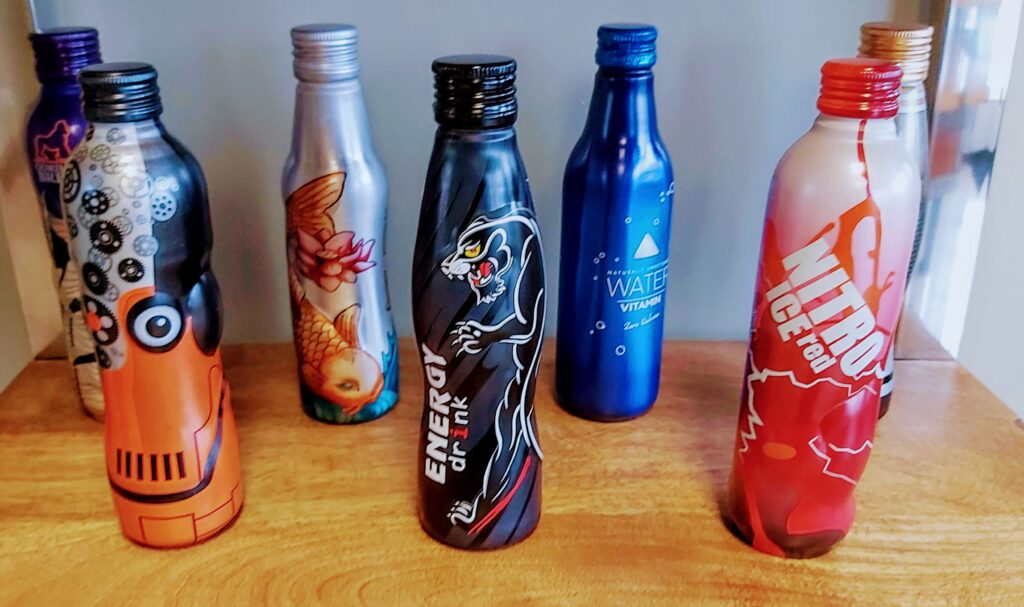
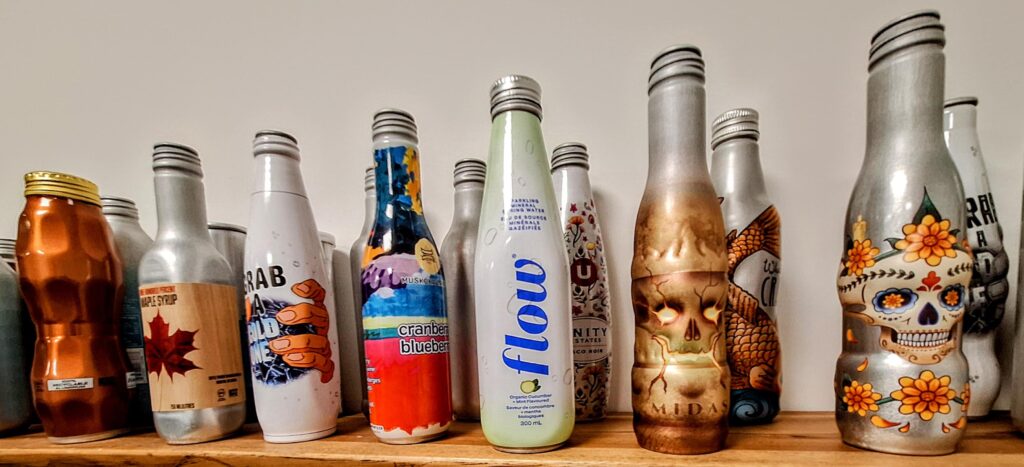
The headline capability is shape. KAT can produce essentially any silhouette a designer can imagine. Tall and slender, squat and sturdy, a classic long-neck, a sculpted form no one has seen before. A 3D printer makes the mould for each shape, which keeps the cost of a new shape low enough that a small brand can actually afford one.
Beyond the silhouette, the metal can carry embossed three-dimensional relief — a raised logo, a sculpted panel, a quilted texture you feel before you read. Combined with printing, that embossing is the heart of what we call minting: a package struck into the metal itself, almost impossible for a competitor to copy. For a brand that worries about imitation, that is the difference between standing out for a season and owning a look.
Printing and decoration without a label
Most packaging wears its artwork on a sticker. Aluminum does not have to. With direct-to-metal printing, the design goes straight onto the surface of the bottle. No label, no shrink sleeve, no plastic wrap between the art and the metal.
That removes a whole layer of cost and hassle. There is no label stock to buy, no adhesive, no labelling station on the filling line to tune and unjam. There is no sticker to peel, bubble, or drift out of alignment in an ice bath. And there is one less plastic component, so the finished bottle stays cleanly recyclable. For a sustainability-minded brand, removing the plastic sleeve is a claim you can actually defend, because it is simply a thing you took away.
Sizes, formats, and what aluminum bottles can hold
Aluminum bottles are not only for beverages, though beverages are where most brands meet them. KAT’s range spans crown-cap and resealable beverage bottles, child-resistant cans and tubes, and pill or supplement containers. Openings, closures, and volumes flex to the product.
The contents that benefit most share a trait: they are sensitive to light or oxygen, or they simply deserve to look the part. Functional and wellness drinks whose botanical actives degrade under light. Non-alcoholic spirits that must look premium without the alcohol to justify the price. Supplements moving off plastic. And for the cannabis sector, child-resistant aluminum formats protect terpene-rich flower and pre-rolls. They guard against the four things that ruin cannabis: light, oxygen, moisture, and crushing.
Are they sustainable?
Aluminium’s environmental case rests on one stubborn fact: it is endlessly recyclable without losing quality, and the systems to recover it already exist and already pay for themselves. A glass bottle downcycles; a plastic bottle mostly does not get recycled at all. An aluminium bottle can come back as another aluminium bottle, again and again — a point the International Aluminium Institute makes in detail.
KAT’s process strengthens the case at the front end too. Using roughly 30% less aluminium and 60% less energy per bottle means a lighter footprint before the bottle ever leaves the line. Pair that with direct-to-metal printing, which removes the plastic sleeve entirely, and you have a package that is honest about its green claims rather than hopeful. In a market increasingly governed by anti-greenwashing rules, being able to substantiate a claim matters as much as making it.
How much do custom aluminum bottles cost to order?
The honest answer is that cost depends on shape, size, decoration, and quantity. A real number comes from a conversation about your specific project. But the question behind the question is usually about minimums, and there the answer is clear. The global aluminum giants will not take an order under a million units. That minimum has long priced out anyone but the largest brands.
KAT was built for the opposite. Our minimum order is 15,000 bottles, and our sweet spot runs from there to about 250,000. That is the range a growing brand, a craft producer, or a limited-edition run actually needs. That short-run model is the single thing that makes custom aluminum bottles reachable for brands that the conglomerates ignore.
How to source aluminum bottles from a Canadian manufacturer
Sourcing well comes down to matching the maker to the job. The right maker depends on the job. For a custom shape, a short or mid-size run, and a brand that wants a partner rather than a purchase order, a specialized short-run manufacturer beats a global one every time. KAT is family-run, based in Kingston, Ontario, 100% Canadian, and ships across Canada, the United States, and beyond. We hold patents on our forming technology internationally — across Europe, Japan, and Australia among other markets. That protection covers not only us but the originality of the brands we work with.
A typical project moves in clear steps: a conversation about your product and its sensitivities, then a shape and decoration plan, then a sample, then a production run. Brands source packaging four to six months before a launch, so the best time to start is earlier than feels necessary. If you are planning a limited edition or a seasonal release, that lead time is the whole game.
Frequently asked questions about aluminum bottles
What is the minimum order for custom aluminum bottles?
15,000 bottles at KAT, with a sweet spot from 15,000 to about 250,000. This is far below the million-unit minimums of the global aluminum giants.
Can aluminum bottles be made in a custom shape?
Yes. KAT can produce essentially any container shape, plus embossed three-dimensional relief, using 3D-printed moulds that keep custom shapes affordable.
Can you print directly on the metal?
Yes. Direct-to-metal printing puts the artwork on the bottle itself, with no label, no shrink sleeve, and no plastic, which saves cost and keeps the bottle recyclable.
Are aluminum bottles recyclable?
Yes, and that is one of their biggest advantages. Aluminum is infinitely recyclable without quality loss, and recovery systems already exist.
What can aluminum bottles hold?
Beverages, functional and wellness drinks, non-alcoholic spirits, supplements, and cannabis in child-resistant formats, among others. They are especially good for light- and oxygen-sensitive contents.
Where is KAT located and where do you ship?
We are a family-run manufacturer in Kingston, Ontario, Canada, and we ship across Canada, the United States, and internationally.
Talk to us about custom aluminum bottles
Tell us your product, your shape, and your volume, and we will show you what a custom aluminum bottle can do for your brand. See our bottles and shapes, review the frequently asked questions, or reach our sales team through the enquiry form to start a custom order.